Pages

Showing posts with label raajneeti. Show all posts

June 15, 2010

Anurag Kashyap to direct The Godfather Remake


Ek aur Godfather...

Anurag Kashyap's adaptation, Gangs of Wasseypur, based on the coal mine mafia, starts shooting next month

Every B-Town filmmaker has cherished a dream to make his own film adaptation of Mario Puzo's The Godfather.
Feroz Khan did it with Dharmatma, Ram Gopal Varma with Sarkar and Prakash Jha with Raajneeti. And now, it's Anurag Kashyap's turn. His film, titled Gangs Of Wasseypur (named after the Dhanbad area in Jharkhand) where the coalmine mafia exercises a stronghold.

Location change
While Ram Gopal Varma and Prakash Jha chose to set their adaptations in the political domain, Kashyap will shift Michael Corleone's parivaar to the coalmines of Dhanbad. Manoj Bajpayee will play a coalmine owner modelled on Marlon Brando's Don Corleone. The film will also star Nawazuddin Siddiqui, Piyush Mishra and a newbie, Raj Yadav. Shabana Azmi is being considered for a major role.
Produced by UTV, the film begins shooting in July.

Shooting elsewhere
Kashyap has been denied permission to shoot in Dhanbad and will shoot in Singhaul, Bihar instead. Gangs Of Wasseypur will be made in two parts as two separate feature films shot concurrently, just like Ram Gopal Varma's Rakta Charitra.

Nawazuddin Siddiqui, who plays a role inspired by Al Pacino's Michael Corleone in The Godfather, will pay Dhanbad a secret visit to research on Kashyap's most ambitious project to date. Says the excited actor, "It has been my secret desire to play Al Pacino's role someday. We start shooting July-end. It's a fantasy come true."

June 13, 2010

Sarah Thompson moving to Bollywood

Sarah Thompson


After Barbara Mori in Kites another foreign beauty is all set to try her luck in Bollywood. Sarah Thompson who plays Ranbir Kapoor's American girlfriend in Raajneeti is brushing up her Hindi skills ahead of moving to Mumbai.
"When I started working on Raajneeti I knew no Hindi. That was okay. I had to play a girl who doesn't know any Hindi and all I had to do was mutter a smattering of bad Hindi."
But now Sarah has got herself a Hindi teacher. "I want to make a career in Bollywood. For that I need to know the language. So I got myself a teacher. Ab mujhe Hindi bolne aati hai."
She gushes, "I love India and love Indian films. Mumbai reminds me of New York. The same energy and bustle and now I want to be part of it."
This is Sarah's third visit to India. "I came the first time to India to shoot in Bhopal for Raajneeti and then I came to dub for the film. Now I'm back for the release, and I'm nervous and anxious, yeah! I want to do more Bollywood films, and yes I am shifting to Mumbai."
This time Sarah has come laden with a wish-list of Bollywood directors she wants to work with. "I want to meet Vishal Bhardwaj and Rakeysh Om Prakash Mehra. In fact I am meeting Rakeysh Mehra shortly. I saw Rang De Basanti'and I said to myself, 'Why couldn't I have played the British girl in the film?' I've seen Vishal Bhardwaj's Kaminey twice. He's another Bollywood director I really want to work with."
Sarah admits she had not heard of Prakash Jha when he offered her the role in Raajneeti.
"But when I met him and he narrated the role of Ranbir Kapoor's American girlfriend to me I knew I had to do it. He gave me his Gangaajal and Apaharan to watch. And that's how I was introduced to a totally new facet of Bollywood," she said.
"Before watching Prakashji's films I thought Bollywood meant singing and dancing. Here was a gritty realistic cinema that I certainly wanted to be part of," she added.

Read more from HERE

June 8, 2010

The beginning of Kalyug - Raajneeti!


Prakash Jha's films are political, usually on explosive subjects, and rooted in the hinterland. His return to movie making after several years still had Ajay Devgan (except somewhere along the way Ajay dropped an "a" to become Devgn), the film was still on a political subject, and non-metro in focus. Despite by Bihari roots, I am not a huge fan of the earlier Jha films, so I did not have many expectations from Raajneeti.

It was amply clear that Rajneeti would have many elements of the epic Mahabharata once the son born out of wedlock (Karn) was abandoned to be picked up and adopted by a lower-caste couple. However, this is not an exact re-telling of the epic in a modern setting, though much is retained. The battle for political power between two brothers and their progeny is at the heart of this tale, replete with the older getting handicapped, the banishment of the progeny of the younger brother, and the siding of the bastard with the enemies of his half-brothers! But also mixed in is a tale of political intrigue, machinations, explosions, and assassinations. Some parallels to the Godfather are apparent, as is the most obvious parallel to the Gandhi family! Here we have two brothers instead of 5, and the older dies a violent death in a blast. Then his wife picks up the reins of power after his death. Raajneeti is a taut thriller with a relentless pace through the first half, that takes an abrupt turn into a game of political chess with checks after checks in the second half. The pace does slacken and the tale gets a little more outlandish in the latter third of the film, but not enough to let the interest flag.

There are enough deaths and attempted deaths to hint at utter lawlessness in the state that is the arena for this story. But the storyteller's prerogative directs that he tell the story in his own way, creating a reality that he draws us into, while not necessarily creating a "REAL" reality. After all a paralyzed party president would not wield power for months after his incapacitation, nor would elected politicians expect their seat to be inherited. The best way to enjoy Raajneeti is to simply let go of preconceived notions, put aside all thoughts of the Mahabharata and the Indian constitutions and plunge headlong into the story being spun by Mr. Jha and co-writer Anjum Rajabali. This is Raajneeti after all, where women are mere pawns in the game, and where men fight lawfully and illegally, with fists and guns and bombs, and sometimes simply with a quiet statement that pulls the carpet out from under the opponent's feet.

The characters are all shades except white, and the game is a simple one - to win at all costs. The seemingly innocent are not, and most of the conniving is behind the scenes by three of the quietest characters in the film - Nana Patekar, Ajay Devgn and Ranbir Kapoor. The firebrands are Manoj Bajpai and Arjun Rampal, yet they are constantly manipulated by the quiet ones. The women are place holders until we see the alliance between Prithvi Pratap (Arjun Rampal) and Indu (Katrina Kaif), and the setting up of a successor in Indu. However, Jha does present us women with political ambitions. Thus Bharati (Nikhila Tirkha) is a leftist activist influenced by Naseeruddin Shah, Shruti Seth wants the Satara ka ticket, and Indu (Katrina) promises Samar (Ranbir Kapoor) that she will be a minister before he returns. The only woman with no political ambitions is Sarah (Sarah Jane Thompson), the white girlfriend of Samar Pratap. We barely get a glimpse of the woman who tends to her paralyzed husband (as Gandhari did), so she does not quite count. It is also interesting that every woman, except the "knowing and using" Shruti, ends up pregnant. However, it is only the Naseer Nikhila episode that follows a rain drenched 70s "roop tera mastana" type track, the other two are couples who have been in or have begun a committed relationship. But except for Shruti, they are more idealist and pure of heart; the blackness that envelops the menfolk, spares the women. The men start out with a conventional Kaurav badness (Veerendra Pratap - Manoj Bajpai) and Pandav goodness (Prithvi and Samar - Arjun Rampal, and Ranbir Kapoor). But while Manoj Bajpai stays in his role of all for power, and end justifying the means, the brothers rapidly turn to darker and darker shades of gray as the film progresses. Nana Patekar is an adviser and well wisher of the Pandav branch. He is a Vidur like character, as he advises the paralyzed leader to give up his powers to his younger brother, much as Vidur negotiated the transfer of power from Dhritarashtra to Pandu. But later Nana also takes on the role of Krishna and becomes an adviser to the sons Prithvi and Samar as the political battle for succession ensues. The transformation of Samar Pratap seems to happen in the span of a few minutes, but Jha uses the subtlest hints from the youngest member of his cast effectively to show the dying and then dead father, the punch to the face from a policeman, and the arrest of his elder brother. This is enough to awake the inner demons and start Samar off in a game to outmanoeuvre Veerendra Pratap and get his brother Prithvi into power. His intentions are read (and approved) by his uncle, and together they start the game of chess with Veerendra Pratap and Sooraj (the abandoned illegitimate son).

The acting by the male cast is top notch. Leading the pack we have Nana Patekar in a subtle and effective role that subdues his histrionic ability and instead brings out the most nuanced performance from him in a long time. Next comes the performance from Manoj Bajpai. He excels as the conniving and selfish Veerendra Pratap. He wants power and will not wait for it. The anger, the fits of the sullens, and the drunken episodes are all exceptionally well done. Ranbir Kapoor is going from strength to strength and here as the academic who turns into a violent schemer, he is subtle, and with the barest quiver in his cheeks or flicker of an eyelid he conveys a lot. It is not easy to shine in a cast like the one in Raajneeti, but Ranbir manages to do exactly that. Ajay Devgn does not have a big role on screen, though many of the events in the film are set into motion by him in moments not portrayed on screen. I wonder if large chunks of his role ended up on the editing table. He is intense and intense and has very few other emotions. There are two standout moments - one of extreme indecision when he cannot shoot Samar as he now knows the man is his half brother, and the other of shock and disbelief when Samar shoots him. Arjun Rampal does well as the suave Prithvi who wants to be a politician, and one can only blame Jha for turning him into a psychopath in the ending moments of the film. There is no indication in his character graph that he would take such a turn. The women do not amount to much nor do they have much of a role to talk about. The mother, Nikhila Tirkha, is just not a good actress, so her moments on screen drag the film down a bit. Shruti Seth plays the slutty party worker appropriately. Samar's girlfriend Sarah is ok, but her talking is almost like she is teaching an ESL class, enunciating each word carefully. Last but not least, Katrina Kaif is no doubt a big draw in the film, but she is also a big letdown until the final moments. Her lips are inflating at an alarming rate and soon she will not be able to talk at all. The dubbed parts are poor with little sync between lip movements (when the silicone permits movement) and what we hear, and when she does speak it hardly wows as it is supposed to.

Mr. Jha shows mastery over the crowd scenes to the point where one can feel the crush of bodies and smell the dust. This gives the large political canvas a reality that is not usually seen in such films. Enough is shown of the families, their milieu and their interactions to make the lives of these people real and not a cardboard facade. The action sequences are taut and provide thrills enough to keep the audience engaged for the almost 3 hour run time. The end of the Mahabharata signified the beginning of Kalyug, and Rajneeti shows the ugly side of politics in this Kalyug. The characters seem beyond redemption and hopeless. Then in one stroke we have the rise to power of the most idealistic among the group, a woman who wants to distinguish between good and evil, and whose hands have no blood on them. This lifts the film out of bleakness and into a realm of hope.

While thoroughly engaging, this is by no means a flawless film. The casting of Katrina Kaif is incongruous in the mix of mostly excellent actors. The mother is totally miscast....

Read more HERE

June 6, 2010

Cinema politico


Raajneeti is the latest in a long line of films on the theme of Indian politics. Made against many odds, they gathered critical acclaim, but seldom did well at the box office.

Popular cinema, at its best, reflects the social dynamics of its age. And politics being an integral part of society — not just in the sense of the political system but in the wider one of the power equations between genders and communities — popular cinema has had a long-lasting affair with politics. Prakash Jha’s Raajneeti is proof of that.

Jha’s Raajneeti, which he calls his ‘most complete work’, is set against the backdrop of Indian democracy and politics. “It showcases the politics of the mind, the manoeuvring of relationships for power. It’s about the insiders and outsiders of politics,” says Jha, who contested and lost the 2004 and 2009 general elections from his native Champaran (Bihar)and feels his experience came in handy while making Raajneeti.

As for the controversies it has run into — the censor board gave it an A certificate at first, which was only lifted after the filmmakers took the matter to the Apellate Tribunal — Siddharth Roy Kapur, CEO of UTV Motion Pictures, which has co-produced Raajneeti, claims he hadn’t been expecting it. “It’s essentially the Mahabharata in the present political context,” he says.

A film can of, course, be ‘political’ without depicting the political system. As veteran filmmaker Shyam Benegal, also a Rajya Sabha member, says, “There are films which directly depict politics and then there are films which take a tangential look at it.” In that sense, all Benegal’s films are political, including his two recent releases, Welcome to Sajjanpur (2008) and Well Done Abba (2010).

Among Bollywood directors, Sudhir Mishra has well-known political connections. His grandfather D P Mishra was a close associate of Indira Gandhi and his uncle Brajesh Mishra is a former national security advisor. Hazaaron Khwaishein Aisi (2005), his critically acclaimed film about three people caught in the sweeping political changes in the pre- and post-Emergency period, has many resonances with the current debates on Naxalism. Mishra says his film was “a story of people who took choices and failed, but that failure was magnificent. Naxalism is a kind of symptom, not the cause. It was one of the many expressions people found to speak against the government then.”

Political theatre has been crucial in shaping the careers of Anurag Kashyap and Nandita Das — both were associated with Safdar Hashmi’s Jana Natya Manch in Delhi. Das’s career as an actor is full of films with strong political undercurrents — Govind Nihalani’s Hazaar Chaurasi Ki Maa (1998), on the mother of a dead Naxalite; Bawandar (2000), about caste politics and the use of rape as a weapon against women; and Mani Ratnam’s A Peck on the Cheek (2002) on the Sri Lankan Tamil issue, to name a few. Das’s directorial debut Firaaq (2008), a story set in the aftermath of the 2002 Godhra riots, engages with politics — particularly communal politics. “Art is also politics,” she says. Kashyap’s Gulaal too is overtly political, set amid the violent student elections in Rajasthan and a separatist movement there. “It was and is my most angry film,” Kashyap says.

While films such these have almost always got critical acclaim, box office success has not often followed.

Rakeysh Omprakash Mehra’s Rang De Basanti (2006) is an exception, breaking records with collections of Rs 60 crore. Talking about his cult movie, Mehra says, “The boys in RDB are really me and my friends, a disillusioned lot in college who wanted to shoot the politicians. Through the film I also wanted to bring out the Bhagat Singh versus Gandhi rhetoric.” Political apathy in the metros is something Mehra finds disturbing, and it’s an issue that forms the subtext of RDB. “People will talk but won’t go out to vote,” says Mehra. RDB was also effective in the way it set off a wave of candlelight protests such as the one that turned the tide against Manu Sharma in the Jessica Lal murder case.

Controversy has always dogged political films. If Katrina Kaif’s role in Raajneeti is rumoured to have been based on Sonia Gandhi, Gulzar’s Aandhi (1975) raised a storm too because people alleged that it was based on the life of Indira Gandhi. Aandhi did not get a full release while Indira Gandhi was in power, but premiered after she lost the 1977 elections. Gulzar, of course, refutes the allegations, saying that he needed to model his protagonists on someone and Indira Gandhi and Tarkeshwari Sinha fitted the bill. He considers his other films — Maachis (1996), on the Sikh insurgency, and Mere Apne (1971), depicting the frustration of jobless youth in politically turbulent Bengal — more topical.

Mishra recalls the turbulent times before the release of his film, “When you make a film like Hazaaron..., the entire industry mocks you. I had to battle the censors. Earlier too, the Shiv Sena pulled out Dharavi in 1991 from six theatres in which it was running. That was a major challenge.” Even Mishra’s first feature, the searing Yeh Woh Manzil Toh Nahin (1987) angered many.

Das echoes his sentiments, “A journalist called me to say that Narendra Modi wanted to watch Firaaq before its release, but I refused and went ahead.” Then theatre owners refused to screen the film as they feared it might lead to vandalism, and there was no promotion in Gujarat. “People knew about the film but the details were withheld, thereby slowly killing it,” rues Das.

Even RDB ran into a dispute with the defence ministry and Air Force Board wanting Mehra to cut out the portions where a MiG plane is shown crashing and a CAG report reveals a scam worth Rs 2,000 crore.

Some films were banned outright — among them Prakash Jha’s documentary Faces and Storms (1984) on the Bihar Sharif riots, which was banned five days after its release, but went on to win the National Award.

Kapur, however, is optimistic. “Both RDB and Raajneeti were made with the objective of entertaining and, like RDB, Raajneeti will be as successful in doing so.” Bollywood trade analyst Komal Nahta feels that having saleable stars such as Ranbir Kapoor, Katrina Kaif and Ajay Devgn will help the film, made on a budget of Rs 40 crore. “Being a multi-starrer, Raajneeti will see a fantastic opening. The song ‘Mora Piya’ is a rage.”

In other words, Raajneeti is merely political cinema peppered with Bollywood masala, and thus little different from the other stuff that tinseltown dishes out.


June 4, 2010

Raajneeti – Disappointing


One of the most awaited films this year, due mostly to the director and the stellar star cast, Raajneeti carried a lot of expectations on its shoulders. But here we are let down first and foremost by the director himself. Prakash Jha deals with too many characters in this film and in the end it turned out to be a disadvantage for him and the film. I felt a few characters should have been developed more. Ranbir Kapoor’s and Manoj Bajpai’s character were among the very well written ones. Ajay Devgn’s character too had “dome” motive in the start, but in the second half even his actions were not well justified. Katrina Kaif was hardly even there in the first half.

The major problem of Raajneeti is the scripting; Jha gave more preference to how to bring in Mahabharata in the film than to concentrating on the current politics, which should have been the main plot. The elements and characters of Mahabharata should have been add-ons. He was concentrating more on the character of Dhrithrashtra who was a less important character in Mahabharata, at least if we are only using elements of Mahabharata in a different story to tell. And Raajneeti wasn’t staying so true to Mahabharata that it should have characters like Dhrithrashtra when there are only 2 Pandavas and Dhrithrashtra has only one son.

The film turns into an unintentional comedy because of all these extra doses of Mahabharata going on and a few more scenes of poor writing. Katrina Kaif saying “I love you” to Arjun Rampal and when Ranbir/Arjun’s mother tries to tell Ajay Devgn that she is his real mother are laughable moments. And in a film which is supposed to connect with the youth, who uses words like ‘jaisth’ (meaning eldest) in the dialogs - “Tum mere jaisth putra ho.”

It also turns illogical sometimes, when you see a mother going to meet someone when she has just lost her son and hasn’t even performed the antim sanskar. The film really misses the word EMOTION. Everyone here including brother, sister, mother, father was more interested in politics than their personal relationship. It is true in politics, people are more concerned about winning and losing, but even a mother? I can’t take that. Katrina Kaif was married to Arjun Rampal because he was standing up for the post of chief minister. I don’t see why a father of a girl will sell her daughter to a person and give over 50 crores rupees as dowry; especially when her daughter is Katrina Kaif. And Katrina Kaif did not turn the match down, which again was unjustified. The script really needed more effort and even though the duration of the film was around 170 mins, it still was incomplete. Although after seeing how the things going in the film and emotional moments turning into hilarious scenes, I was happy it was left incomplete. It would have been difficult to take more.

Read more from HERE

April 18, 2010

Raajneeti Preview And Stills


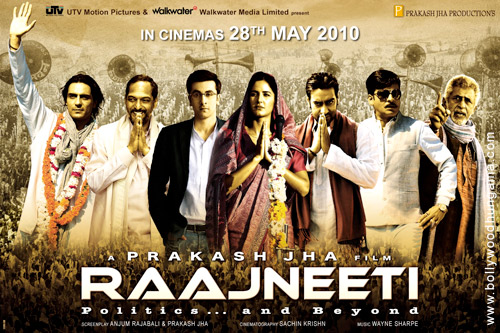
Coming up on June 4th is Prakash Jha's epic film Raajneeti. Epic in scope and in story, the film required the director to assemble an all star cast of some of the finest actors in Hindi cinema including: Manoj Bajpai, Naseeruddin Shah, Ajay Devgan, Nana Patekar, Arjun Rampal, Katrina Kaif and Ranbir Kapoor.

Synopsis: Raajneeti is a story about Indian politics. About Indian democracy. About Indian elections. Above all, it is the story of a few people who control the destiny of millions. It is the story of their unstoppable ambition, and their bitter and violent battle to achieve it. This is the story of people who understand power - and know how to wield it at will.

It is the story of Bhasker Sanyal (
Naseeruddin Shah), the fire-brand leftist leader, as feared for his single-handed ability to challenge the most powerful of leaders as he was respected for his political integrity. Until one private mistake of his hurtled him into a self-imposed exile and spawned a secret consequence that shook the destiny of the political future of the state.

And of Sooraj (
Ajay Devgan) who rose from the backward classes - with anger in his heart and leadership on his mind. And yet, his destiny could never overcome the tragedy of his birth, trapping him in a terrible dilemma where his loyalty to his friend threatens to destroy his own family.

Of Brij Gopal (
Nana Patekar), who shunned every political ambition even as he continued to mentor and guide the younger generation of leaders while the battle got bloodier by the day.

It is the story of Prithvi Pratap (
Arjun Rampal), heir to a powerful political legacy and impatient to seize the top position. A man with a heart of gold but who is all brawn. A man whose uncontrollable passions bring his family to the brink of political extinction.

And of Veerendra Pratap (
Manoj Bajpai), whose lunge at the throne was thwarted even as he was within striking distance of it. A man who believes he was born to rule, and who will now stop at absolutely nothing to claw his way back to the top.

Of Indu Sakseria (
Katrina Kaif), the princess - beautiful, passionate, arrogant. She had only one all-consuming love. Little did she know that her personal happiness was dependent on the changing electoral fortunes of her love, and that even a slight shift in the faultlines of political negotiation would cause a devastating earthquake in her personal life. And yet, this spirited never-say-die diva rose from the ashes of her tragedy to challenge every contender, over-turning the political future of the state.

Of Sarah Jean Collins (
Sarah Thompson), who came from one of the bloodiest and most violent places on earth. Who escaped from there, bruised, hurt, and fell in love with a soul-mate who shared a similar legacy. And her abhorrence for it. And yet, when he was sucked into his destiny, this innocent bewildered girl's private world was thrown asunder.

And, it is the story of Samar Pratap (
Ranbir Kapoor), the ultimate outsider. The apolitical conscientious objector, who got reluctantly sucked into the battle-ravaged arena of family rivalry. Only to turn into a master of the craft of political warfare. It is the story of the woman that he loved, and the one that loved and lost him. It is the story of his determined and fierce fight to protect his family. Of the bloodiest of final battles in a war alien to his character.It is the story of a man's descent into the moral hell that is Indian politics.

It is the story of a fiercely fought election campaign, where money-power and corruption are the accepted norms, and where treachery and manipulation are routinely used weapons. As the personal drama of these conflict-ridden characters unfolds against this gritty backdrop, love and friendship become mere baits, and relationships get sacrificed at the altar of political alignments. The darkness that rises from their souls threatens to envelope all that they hold precious. Until eventually, in the crescendo of increasing violence, the line between good and evil blurs, making it impossible to distinguish heroes from villains.

Raajneeti is the story of Indian democracy. And its ugly underside. It is about politics. And beyond.


Samar Pratap: "The outsider, who overturned every rule of the game"


Sooraj Kumar: "The underdog, whose game-plan stunned the rulers"


Prithviraj Pratap: "The challenger, who staked his life for power"


Bhaksar Sanyal: The revoltionary, who mysteriously disappered"


Brij Gopal: "The mentor, who fought the battle without weapons"


Veerenda Pratap: "The inheritor, who believed power was his birthright"


Sarah Jean Collins: "The innocent, who asked for nothing and lost everything"


Indu Pratap: "The diva, who was forced into the battlefield"


LINK

February 19, 2010

Raajneeti Postponed

LINK


Kites and Rajneeti are seen by the film trade as the two most crucial releases in mid-2010. As the films’ producers Rakesh Roshan and Prakash Jha are close friends, Jha has decided to shift  the release of Raajneeti from May 28 to June 4 on Roshan’s advice as Kites, directed by Anurag Basu, will release on May 21 .


Jha said, “Both Rakeshji and I felt there should be a two-week gap between Kites and Raajneeti. Earlier my film was to release just a week after Rakeshji’s film, but in the case of a big film like Kites multiplexes don’t know till  Wednesday if they would like to change the film schedules on Friday. As I wanted to avoid this confusion, Rakeshji and I decided it was better that I postpone Raajneeti by a week because there’s no big release after Raajneeti until  Mani Ratnam’s Raavana.”

Roshan said, “I think more filmmakers need to work in close consultation to avoid films overlapping and cutting into one another’s market. Jha and I have mutually decided his film should release a fortnight after mine.”